Will your 3D printed RC plane fly? Check these four numbers first
Most first-flight crashes of printed planes come down to four things: the CG, the wing loading, the thrust-to-weight ratio and the stall speed. Work them out from your build's real weights before the maiden, then fly the same setup in a simulator to see how it handles at launch and on landing.
Fly Before is the RC flight simulator for Mac that runs real ArduPilot in one click. Plug in your radio and practice every step on your Mac before you go to the field. See what Fly Before does
Printed planes take weeks of print time and a lot of filament, and they are often heavier than the designer's estimate once glue, wiring and a bigger battery are in. The maiden is where that weight shows up. None of the checks below need special software; a scale, a ruler and the build manual get you most of the way. A simulator adds the part a spreadsheet cannot: how the numbers feel on the sticks.
The four numbers
| Number | How to get it | What Fly Before's Workshop flags |
|---|---|---|
| CG and stability margin | Balance point from the leading edge, compared with the manual's CG | Margin below 0%: error. Below 4%: warning. Above 40%: too far forward. Our stock airframes sit at 8–19%. |
| Wing loading | All-up weight divided by wing area, in g/dm² | Above 75 g/dm²: note. Above 100 g/dm²: warning. |
| Thrust-to-weight | Static thrust (from a thrust stand or the motor maker's table) divided by weight | Forward thrust below 0.5 of weight: warning. VTOL lift thrust below 1.05: error, below 1.4: warning. |
| Stall speed | From weight, wing area and the wing's maximum lift coefficient | Shown as the Slow flight gauge; lower means easier hand launches and landings. |
The Workshop thresholds are our model's warning limits, chosen to catch mistakes. They are not design rules from the plane's designer; always follow the build manual first.
Work through it
- Weigh everything. Weigh the printed airframe, then the motor, prop, ESC, battery, servos, receiver and camera. Designers' weights usually assume a specific filament and infill.
- Find the CG in the manual. It is usually given as a distance from the wing's leading edge. Mark it on the wing.
- Plan battery position. Work out where the battery must sit to hit that CG with your actual nose and tail weights. If it cannot, you need ballast or a different battery before you fly, not after.
- Compute wing loading. Divide all-up weight by wing area. A heavier-than-planned printed plane often lands well above the designer's figure; expect a faster launch and landing.
- Estimate stall speed. The lift equation (lift = ½ × air density × speed² × wing area × lift coefficient) gives the speed at which the wing can just carry the weight. More weight or less area means a higher stall speed.
- Check power. Compare your motor and prop's static thrust with the weight. For hand launches, enough thrust to climb away from the throw matters more than top speed.
- Check current. Make sure the motor, ESC and battery limits all cover the full-throttle current with the prop you plan to use. A bigger prop can quietly overload the motor.
Then fly it in the simulator
In Fly Before's Workshop you can start from a similar airframe (Trainer, Explorer, Flying wing, Motor glider, Tilt-rotor VTOL and others), set your motor, prop, battery, ESC, extra weight, balance point and control throws, and read the four gauges: Power, Flight time, Slow flight and Balance. The bench test runs the motor in place and shows thrust, current, power and motor temperature. One button then puts that setup on the field.
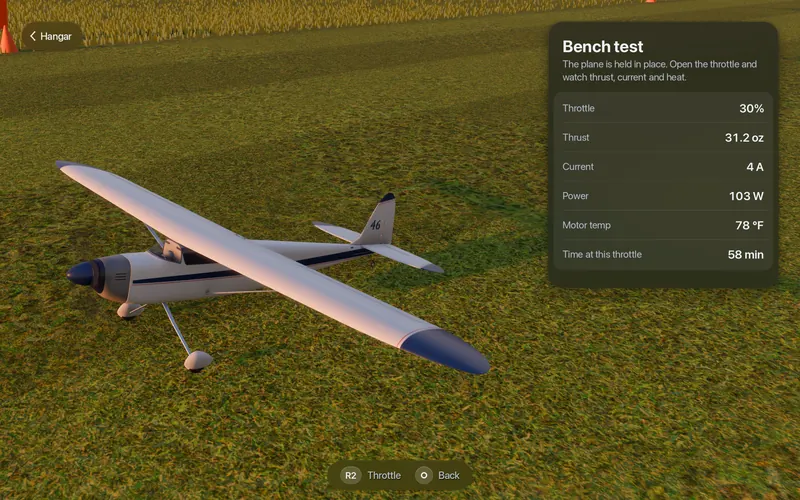
What to try in the sim with your numbers:
- A hand launch at your real weight. Does it climb away, or sink before it builds speed?
- A slow pass and a stall. How does it drop a wing at your CG?
- A landing approach. Is the approach speed manageable for your field?
- CG moved a few millimetres back and forward, to see how sensitive it is.
Bringing in your own airframe
If none of the stock airframes is close, you can add your own from its STL files. Today that is a hands-on process: put the STL files in a folder, write a short settings file (including the CG from the manual), line the parts up in a preview, convert them with the conversion script, then correct the numbers with a scale and the manual. If a model file is missing, the plane still flies with a simple stand-in shape.
How good are the numbers? They are model output. Against manufacturer motor-and-prop thrust tables, at full throttle across 41 test rows, our model's thrust is off by about 7% and current by about 9% on average, with the worst single row around 25%. Manufacturers' own tables for the same prop differ by around 17%. The flight report assumes no wind, sea level and a full battery, and counts cruise time on 80% of capacity. The stability margin ignores the fuselage's destabilising effect, so the real margin is a little smaller. Use the sim to compare setups and catch mistakes; measure current with a watt meter and balance the real plane before the maiden.
Questions
What thrust-to-weight do I need for a 3D printed plane?
It depends on the plane and how you launch it. As a rough check, Fly Before warns when forward thrust is below half the weight, and for VTOLs when total lift thrust is below 1.4 times the weight. Hand-launched planes need enough to climb away from the throw.
How accurate are simulator power numbers?
Ours are model output. Against manufacturer motor-and-prop thrust tables, thrust at full throttle is off by about 7 percent on average across 41 test rows, and by about 25 percent in the worst single row. Measure current with a watt meter before the maiden.
Fly Before: RC Flight Simulator is a native macOS app (Apple Silicon) for flying RC planes and fixed-wing VTOLs that runs real ArduPilot in one click through the free ArduPilot Helper. One-time purchase, not on sale yet.
Sources
- The lift equation: NASA Glenn Research Center
- Propeller theory used in our model: blade element and momentum theory (McCormick, Aerodynamics, Aeronautics, and Flight Mechanics; Leishman, Principles of Helicopter Aerodynamics)
- Model accuracy figures: Fly Before's internal comparison against published motor-manufacturer thrust tables, November 2026
Changelog
- : First published.