Can you practice slope soaring and gliders on a simulator?
Yes, if the simulator models lift from the terrain. Practice beats along the windward face of the ridge, always turning away from the slope, staying out of the sink behind the crest, and landing on the top or the face. Then practice thermals over flat ground. Fly Before has a slope field where ridge lift comes from the terrain and the wind, thermals you can switch on, and two gliders.
Fly Before is the RC flight simulator for Mac that runs real ArduPilot in one click. Plug in your radio and practice every step on your Mac before you go to the field. See what Fly Before does
Gliders teach you to read the air, and the air is the one thing you cannot see. A slope that works on Saturday can be dead on Sunday because the wind swung 30 degrees. A simulator will not replace a day on the hill, but it lets you learn where the lift should be and rehearse the moments that end flights: a turn toward the slope, a drift back over the crest, a landing in turbulent air.
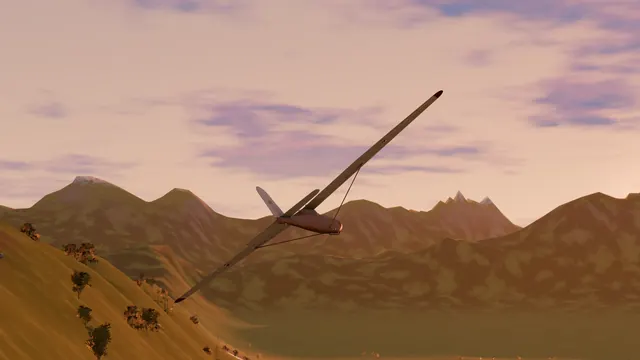
How Fly Before models the slope
On the slope field the vertical air movement is computed from the shape of the terrain and the wind, at every point the glider flies: air rising up the windward face, more of it when the wind is stronger and the slope steeper, less of it the higher you climb, and sinking air on the lee side. Change the wind direction in Field and weather and the lift moves with it. On flat fields there is no ridge lift. Thermals are a separate switch, and the Ride the thermal lesson asks you to stay up in one for three minutes.
The slope drill
- Launch into the wind off the face, wings level, nose slightly down so it keeps flying speed.
- Fly beats along the ridge, parallel to the crest and out in front of it.
- Always turn away from the slope, out into wind. A turn toward the hill in lift ends on the hill.
- Stay forward of the crest. If you drift back, point the nose into wind and lower it to gain speed and come forward.
- Find the best band. Try beats closer and further out, higher and lower, and notice where the glider climbs.
- Land on the top with a little extra speed and a firm decision, or on the face into wind.
Two gliders, two lessons
| Glider | How it flies | Good for |
|---|---|---|
| Motor glider | Glides long and climbs in thermals; a motor to climb out | Thermal practice over flat fields, and the Ride the thermal lesson |
| Vintage glider | Strut-braced, very slow, long glide, folding nose prop | Gentle slope flying and slow, low passes along the ridge |
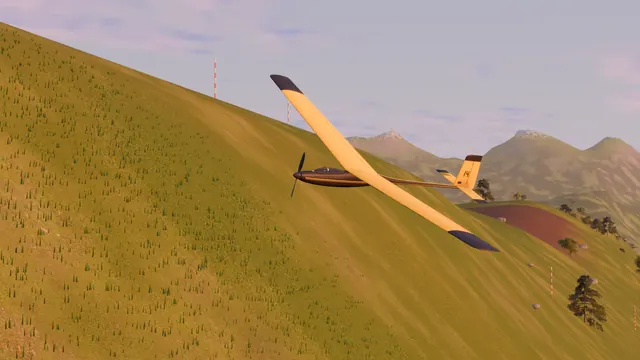
Thermals over flat ground
Without a hill, lift comes from rising columns of warm air. Climb out with the motor, then glide and watch the glider: a wing kicked up or a sudden climb means lift. Turn toward the lifted wing and circle, widening or tightening the circle to stay in the strongest part. In Fly Before, switch Thermals on in the weather settings and fly the Ride the thermal lesson until three minutes up feels normal.
Limits: our ridge lift is a model of the air over the terrain, not a measurement of a real hill, and real slopes add rotor, gusts and wind shifts that no simulator reproduces fully. Learn the pattern here, then fly a real slope with someone who knows it.
Questions
Where is the lift when slope soaring?
In front of and just above the ridge, on the side the wind blows into. The air is pushed up the face of the slope, so the lift band sits over the windward face and leans a little into the wind. Behind the crest the air sinks and tumbles, which is why you never fly a glider far back over the top.
How strong does the wind need to be for slope soaring?
It depends on the glider and the hill. A light foam glider can stay up in a breeze on a steep face, while a heavier model needs more. The wind also has to blow fairly straight into the slope; wind along the ridge gives little lift.
Is a slope soaring simulator worth it?
Yes for the two things that are hard to practice on the hill: turning away from the slope every time, and landing on a slope in rotor. A simulator lets you fly those dozens of times without a walk down the hill to fetch the plane.
Fly Before: RC Flight Simulator is a native macOS app (Apple Silicon) for flying RC planes and fixed-wing VTOLs that runs real ArduPilot in one click through the free ArduPilot Helper. One-time purchase, not on sale yet.
Sources
- Fly Before slope and thermal model: the app's field and weather settings and lesson list (November 2026)
- Slope soaring basics: Academy of Model Aeronautics, Introduction to Slope Soaring
Changelog
- : First published.